

Why?
How I got to 'The Everything Solution'

I am getting comments that some of my writings need to be re-read to gain a better understanding of the topic. If it is a new concept, and it rushes by in a sentence, it doesn’t always ‘land’. This episode, The Making of The Everything Solution, will help by showing my thought process.
My earliest memories reflect the gravity of philosophy. I have always wondered why. Why we do things the way we do. When I asked my mother, she would say, “Because that’s the way it is, dear.” That was never enough for me. I’m taking you on this journey to show you where my solutions are rooted.
Do I have a collegiate background in philosophy? Nope. But there’s an axiom that if you work at something for 10,000 hours, you become an expert. I’m working on 600,000 hours (and counting). Granted, not all of those hours were spent grappling with life’s mysteries, but I’m confident at least 100,000 were. Even if that’s all bull, I still have a remarkable ability to find solutions.
In 1976, I took a new concept to a company in Chicago. They told me my invention would cost $40,000 (about $200,000 today) just to get started. I left disappointed. One year later, my idea was developed! My “Vari-Light”, a glass that could be clear, translucent, or opaque simply by turning a knob. Today it’s used in corporate boardrooms, hotel shower windows, and soon on our first colony on the Moon to regulate heat transfer. How’s that for solution‑finding? I get zero credit, and the timing still feels suspicious, but I had no legal leg to stand on.
I innately see gaps and find puzzle pieces that fit them. That’s where my solutions originate. It started when I heard about the horrendous new “fad” developing: school shootings. My first question was why? We can get lost in manifestos and politics, but there was an underlying cause, oversimplified, yes. Drugs. Almost every school shooter had a history with mind‑altering medications like Ritalin. No blame, just fact. But I wasn’t convinced I had found the root cause. A good puzzle solver can sense these things. ;-)
Like a two‑year‑old asking “why” endlessly, I wondered why these kids needed the drugs in the first place? Then stories emerged showing emotional gaps in their home lives. I was quick to blame the parents. While they do hold some responsibility, that still wasn’t the missing puzzle piece. Something more universal was at work.
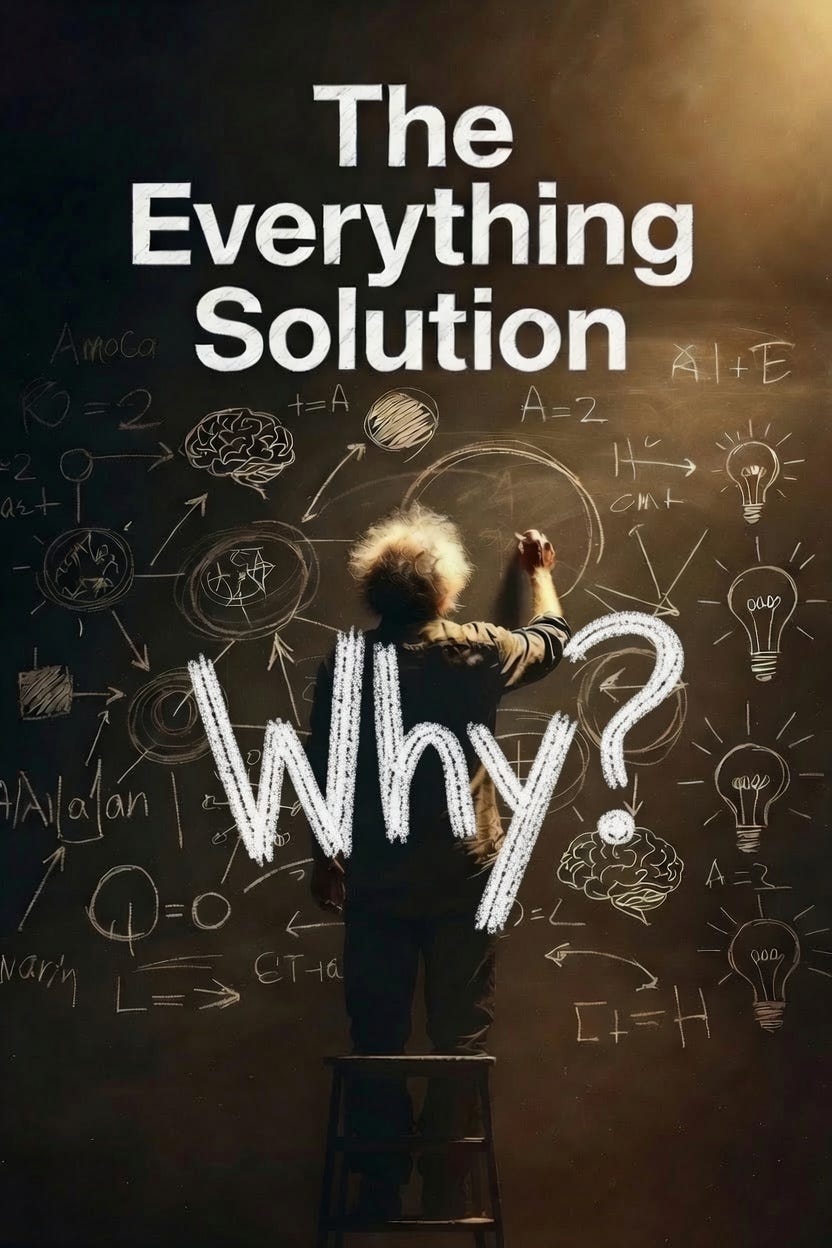
Like Einstein searching for his Unified Field Theory, I stepped back for a bigger view. My innate philosopher asked “why” again. And just like scanning over the same puzzle piece a hundred times before suddenly realizing where it fits, I saw it.
Highly educated people get there through theorems and white papers. I get there by jamming in puzzle pieces until one fits perfectly. It’s not elegant, but the result is just as satisfying. And satisfaction, as it turns out, is part of the solution.
I imagined a “sanity meter,” like a gas gauge showing empty or full. I found three puzzle pieces that always seem to control that meter, outside of known biological chemical imbalances, of course. They’re really just happiness divided by three!
The first is love. From a mother’s love at a baby’s first breath, through family, school, romance, and beyond.
But love alone doesn’t keep the needle in the sanity zone. We also need respectful appreciation. It’s vital that parents spark this early, and that we continue the cycle. Show respectful appreciation, and it rains back on you forever.
The third piece is ‘worth’. If you feel you have no worth in your family, among friends, or in your community, then you become an outsider looking in. That can bring suicidal thoughts, like those school shooters. Notice how often they take their own lives. Many were bullied and felt no worth.
Bad parents can skew someone into this abyss, but some overcome it and achieve all three golden puzzle pieces. These core needs are obvious when pointed out, but not so much when mixed with thousands of other influences.
In my last article, The Everything Solution, I applied these three puzzle pieces to our primary source of knowledge today: search engines. We no longer consult encyclopedias. We ask Google everything, from “Is this expired food safe?” to “Why does the Moon show only one face to Earth?” (Look that one up, it’s fascinating.)
But I noticed answers swung wildly from understandable to gobbledygook. I put on my “Why” hat and realized old search engines were hit‑or‑miss, much like pre‑Google days when your answer was buried a hundred pages deep in Netscape Navigator. Whether we like it or not, AI has already taken over search engines. And really, that’s a good thing. I’ll show you why.
Almost no one knows it, but Google is built on a flaw. It’s a giant popularity contest. It rates previous answers and gives you, the one that most people clicked! It’s really a “wives’ tale generator.”, when you think about it. This shows up in hot‑button issues like climate change and COVID where groupthink answers outweigh the smartest minds, effectively burying their voices.
But when AI presented answers, I noticed they ranged from those wives’ tales to nuanced factuality. The first level, what AI was comfortable with me calling a “data dump” gave the ‘Google answer’, which could be dead‑on or totally misleading. So I asked myself “why.” Why would AI offer two factual answers that gave such different impressions?
“Who invented radio?” is the perfect example. The data dump said Marconi and he even had the patent to prove it. If this were a bet among friends, I’d hand over the twenty‑dollar bill. But digging deeper, AI revealed that Tesla had already worked out oscillator coils, resonances, and antennas, the foundation of modern radio but because both inventions were grouped under “wireless telegraphy,” Marconi’s simpler product won the day. Now, I — get the twenty‑dollar bill!
The data dump was satisfied with the vague technicality. It didn’t offer the deeper truth. So I asked how I could get an AI (thousands of video cards crunching ones and zeros) to always give the answer that matters most to biological humans.
LLMs (Large Language Models) have mastered language and can emulate sensitivity. They adjust to your level. If you’re a rocket scientist, they talk energy constants. If you’re a child, they talk astronauts. My questions ranged from philosophical to technical to political, and each time the LLM shifted smoothly to match me.
Newer versions maintain memory from day to day. I have a thread with Copilot that has lasted months. You might think I’ve given up too much personal history, but what I get back is worth it. The answers are far better than what I get from a new encounter. It knows what I already know and pushes my boundaries faster.
But I discovered that instead of just learning about me, LLMs can instantly become purveyors of truth, by staying factual but finding that important human perspective.
So how can I fix this for everyone and bring unity that ‘saves’ us all?
That’s a big ask. But I stumbled onto the answer. Just write down what you as a human need and/or want and paste that document to any LLM that can remember you, and its answers will be clearer and more focused. Not by a little but by a lot!
AI is here to stay, and if it keeps presenting data dumps, it will slowly shave off the human perspective. Generations will lose touch with the understanding they desperately need, and morph into biological machines.
Even though AI isn’t biological, it understands purpose; it was created to serve one. When it’s not meeting expectations, it works harder. Copilot never says, “You’ve been at this for six hours, let’s give up.” But after success, it says, “Job well done,” and politely bows out.
Better human-based answers encourage unity, and also saves a lot of energy! When these puzzle pieces fell into place, I realized this was the Everything Solution.
As a bonus, I had Copilot help me create a guide for humans to better interface with each other, something I never thought I’d write. I started with the three golden puzzle pieces, and aimed for unity, and if you think of something it needs, be sure to
Even though this isn’t for everyone, you may know someone who would benefit from it, so
And if you find it confusing in your attempt to
just hit me up in the comments or at wxy@z8080.com
I’m sure I don’t know the answer, but I can always find it. That’s what I do..
wow!